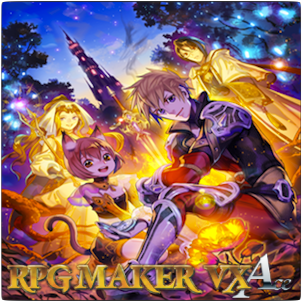
Download : http://rpgmakervxace.com/tkool/products/rpgvxace/
If You Want English Edition ,Download : http://torrentz.eu/efd7480c428c3552cde1dd34a1aad9cb2b9e5494
RPG Maker 2003 (RPGツクール 2003) is the third in the series of programs for the development of Role-Playing Games, developed by the Japanese group ASCII. It features a database of pre-made backgrounds, music, animations, weapons and characters.
Graphics
All graphics within RPG Maker 2003 are in 2D like its predecessor, RPG Maker 2000, and makes use of the same graphical resources with a few minor changes in resolution. In addition, Battle Character and System2 sets are used to go with RPG Maker 2003's new battle system. Sprites
The majority of all graphics within the game are achieved with sprites, or single images that has a composition of frames in a specific orientation so that the graphics rendering software of RM2k3 can give the impression of movement.
Music
RPG Maker 2003 allows the use of MIDI and WAV much like RPG Maker 2000, its predecessor, for background music, but in addition now also allows the use of MP3 files which was a strongly desired feature in RPG Maker 2000. RM2k3 does not support any audio editing software so a third party program is needed in order to compose desired sounds.
Runtime Package
RPG Maker 2003, much like its predecessor RPG Maker 2000 and its successor RPG Maker XP, comes with its own set of Runtime Package files, also known as the RTP. The RTP is a whole set of default graphics, music, and sound effects that are used in RPG Maker 2003 and, in most cases, the RTP must be downloaded to the computer to play the games made with RPG Maker 2003. Thanks to the RTP, created games can lessen their file size if a lot of material from the RTP was used.
Bonus contents
Early order also included RPG Maker Alpha (RPGツクールα) I-mode i-appli for NTT DoCoMo 503 or later platform.
RPG Maker 2000 was originally released asRPG Tsukūru 2000(RPGツクール2000) in April, 2000 in Japan. Although, outside Japan, it has only received weak distributions among Taiwan and South Korea markets, it has undergone unauthorized translations into various languages, and illegal distribution via Internet. Enterbrain later released its inexpensive version,RPG Tsukūru 2000 Value!, in May, 2003, which also included some major updates that allow, for example, to use a larger number of picture files simultaneously.
RPG Maker 2000 was the most popular RPG maker of its time; being discussed on many popular websites, and enjoyed a large userbase for many years.This was amplified by the fact that many popular RM2K sites refused to adoptRPG MAKER 2003.RM2K was first taken over by RPG Maker 2003, but has now been superseded by RPG Maker XPand is no longer as popular as it used to be. RPG Maker 2000 was also one of the RPG Makers to be illegally translated and distributed by the Russian programmer Don Miguel.
Compared to RPG Maker 95, RM2K features lower-resolution graphics than RM95, using 16x16 tiles instead of 32x32 tiles, but has other visual improvements such as a higher frame rate, weather effects and panorama backgrounds. It also includes an extra layer for tiles, jumping characters, additional functions and customizable message and menu boxes.
RPG Maker 2000 uses a 320 x 240 screen resolutin for playing games, and has 16x16 pixel tiles, with 24x32 character spirites. Its default green message-window and menu systems are one of the first signs that a particular game was made with RPG Maker 2000, although it can be customized. Some may view these low-res graphics as a limitation, but they could also be viewed as an advantage, because the low-res graphics are not only more compatible with older computers, but sometimes they can be much easier to draw.
RPG Maker 2000 uses a Dragon Quest-like battle system which features a classical turn-based, "front-view" battle system, where the enemy faces you directly on the screen and you do not see your characters on screen. With some tweaking, the battle system can be made to look somewhat like a "side-view" battle system.
The music featured in RPG Maker 2000 consists of a large collection of MIDI and, less commonly, WAV files. Through the use of unofficial patches, MP3 files can also be used, though reliability with said patch has always been an issue. RPG Maker 2003, the successor to RPG Maker 2000, has included official support for MP3 files by popular demand from its users.
RPG Maker 2000 was the first in the series that introduced the "Runtime Package", also known as "RTP", which was also adopted by the later PC versions. The RTP is a whole set of default graphics, music, and sound effects that are used in RPG Maker 2000 and, in most cases, the RTP must be downloaded to the computer to play the games made with RPG Maker 2000. Thanks to the RTP, created games can lessen their file size if a lot of material from the RTP was used.
You want make a rpg game? you are lucky this time, because you reading this article. this time we will discuss about how to make a RPG game. For that, please look at some of the following article:
Kingdom Hearts II (Japanese: キングダムハーツII Hepburn: Kingudamu Hātsu Tsū?) is an action role-playing game developed by Square Enix and published by Buena Vista Games and Square Enix in 2005 for the Sony PlayStation 2 video game console. The game is a sequel to the 2002 Disney Interactive and Square collaboration, Kingdom Hearts, which combined Disney and Square elements into an action role-playing game, though it is somewhat darker in tone than its predecessor. The game's popularity has resulted in a novel and manga series based upon it and an international version called Kingdom Hearts II Final Mix, released in March 2007.
Kingdom Hearts II is the third game in the Kingdom Hearts series. It picks up one year after the events of Kingdom Hearts: Chain of Memories.Sora, the protagonist of the first two games, returns to search for his lost friends.Like the previous games, Kingdom Hearts II features a large cast of characters from Disney films and Final Fantasy games. Organization XIII, a group introduced in Chain of Memories, also reappears to impede Sora's progress.
The game was well-received, earning year-end awards from numerous video gaming websites. In Japan, it shipped more than one million copies within a week of its release. One month after its North American release, it had sold over one million copies and was the second best-selling game of 2006.As of March 31, 2007, the game has shipped over 4 million copies worldwide.
Gameplay
The gameplay of Kingdom Hearts II is similar to that of Kingdom Hearts, though developers made an effort to address complaints with the previous game.The player directly controls Sora from a third person camera angle,though first person perspective is available. Most of the gameplay occurs on interconnected field maps where battles take place. The game is driven by a linear progression from one story event to the next, usually told in the form of a cutscene, though there are numerous side-quests available that provide bonuses to the characters.
Like many traditional role-playing video games, Kingdom Hearts II features an experience point system which determines character development.As enemies are defeated, the player and allies gain experience which culminates in a "level up", in which the playable characters grow stronger and gain access to new abilities.As in the first game, Kingdom Hearts II allows a certain degree of character customization through a short tutorial found at the beginning of the game.
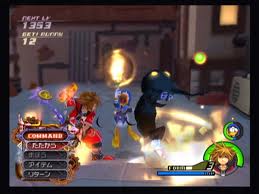
Combat in Kingdom Hearts II is in real-time and involves button presses which initiate attacks by the on-screen character. A role-playing game menu, similar to those found in Final Fantasy games, at the bottom left of the screen provides other combat options such as using magic, summoning beings to assist in battle, or executing combination attacks with other party members.A new feature is the "Reaction Command", special enemy-specific attacks that are triggered when the player presses the triangle button at the correct time during battle.Reaction Commands can be used to defeat regular enemies or avoid damage, and are sometimes necessary to complete a boss battle.In addition to the main character, two party members are usually present who also participate in combat. Although these characters are computer-controlled, the player is allowed to customize their behavior to a certain extent through the menu screen, such as attacking the same enemy Sora targets.
In response to criticism, the "Gummi Ship" feature of the first game was re-imagined to be "more enjoyable". Although retaining its basic purpose of travel, the previous system was completely redone to resemble a combination of rail shooter and "Disney theme park ride".In the world map, the player must now control the Gummi Ship from a top-down view and fly to the world the player wishes to enter. Worlds are no longer open from the beginning—the player must unlock the routes to them by entering a new level, controlling the ship from a third-person point of view, and battling enemy ships.After the route is opened, travel to the world is unimpeded, unless it is blocked again due to a plot related event.
Drive Gauge
One of the new features is a meter known as the "Drive Gauge". The Drive Gauge has dual functions: to transform into a "Drive Form" or to summon a special character. While in a Drive Form, Sora bonds with party members to become more powerful and acquire different attributes; most Forms also allow the use of two Keyblades. When a Drive is executed, Sora's combat statistics are heightened. Drive Forms also give Sora new abilities that can be used in normal form, called "Growth Abilities." Sora's first two Drive Forms only combine power with one party member; later-obtained Drive Forms require him to bond with both party members. When allies are used in a Drive, they are temporarily removed from battle for its duration. Unlike the HP and MP gauges, the Drive Gauge is not refilled at save points.
Like in the first game, Sora can summon a Disney character to aid him in battle. Summons will replace the two computer-controlled characters and fight alongside Sora for as long as the Drive Gauge allows, or until Sora's HP runs out. Instead of being limited to only one action, Summons now have a menu of their own and are capable of performing solo or cooperative actions with Sora. These actions are performed by pressing the triangle button. The Summon ability and each Drive Form are leveled up separately and by different criteria. Obtaining higher levels allows for extended use and in the case of Drive Forms, access to new abilities.
Setting
The setting of Kingdom Hearts II is a collection of various levels (referred to in-game as "worlds") that the player progresses through. As in the first game, Kingdom Hearts II allows the player to travel to locales from various Disney works, along with original worlds specifically created for the series. While in the first game, Disney-based worlds were primarily derived from the Disney animated features canon, Kingdom Hearts II introduces worlds that are based on Disney live-action films as well.Each world varies in appearance and setting, depending on the Disney film on which it is based. The graphics of the world and characters are meant to resemble the artwork style of the environments and characters from their respective Disney films. Each world is disconnected from the others and exists separately; with few exceptions, players travel from one world to another via a Gummi Ship.
Some worlds featured in the previous games reappear, but with new and expanded areas. There are also new worlds that are introduced, including the Land of Dragons, a fictionalized version of ancient China from the film Mulan; Beast's Castle, an 19th century-style French castle based on Beauty and the Beast; Timeless River, a past version of Disney Castle that features Steamboat Willie-style animation; Port Royal from Pirates of the Caribbean: The Curse of the Black Pearl; Pride Land, a great savannah from The Lion King; and Space Paranoids, a digital world based on Tron within Hollow Bastion's computer network. Twilight Town, an original world first seen in Chain of Memories, has a greater role as the introductory world. The World That Never Was is a new world that serves as the headquarters of Organization XIII.
Characters
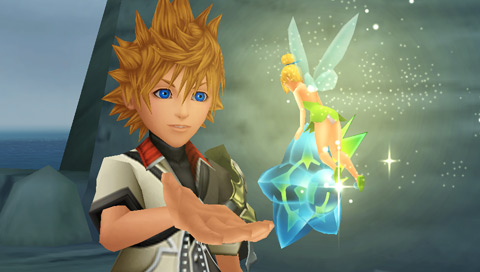
The three main characters in the game are Sora, a 15-year-old boy who was chosen as a wielder of the Keyblade, a mystical key-shaped weapon with the power to combat darkness; Donald Duck, the court magician of Disney Castle; and Goofy, the captain of the Disney Castle guard. Both Donald and Goofy were ordered to find and stay with the "key", which was revealed to be the Keyblade. They befriended Sora during their journey in Kingdom Hearts and draw strength from this friendship. Other original characters include Riku and Kairi, Sora's friends from his home world, Destiny Islands; Roxas, a mysterious boy who can also wield the Keyblade; and DiZ, a man in red robes with a vendetta against Organization XIII.
As in the previous games, there are numerous appearances of characters from both Disney and Square Enix works. While some make a return from Kingdom Hearts, new characters from Disney fiction are also introduced, such as Scar from The Lion King and Scrooge McDuck. Pete appears as a persistent enemy who works with the resurrected Maleficent. Nearly twenty characters from Final Fantasy games appear, notably, Auron of Final Fantasy X, Tifa from Final Fantasy VII, and the return of Squall Leonhart, Cloud, and Sephiroth. It was stated that although the first game strictly stuck to characters Tetsuya Nomura designed, this time around they were going to "take some risks", implying that characters not directly designed by Nomura might make an appearance.Other new characters to series are Vivi of Final Fantasy IX, the Moogles from several Final Fantasy games, and Setzer of Final Fantasy VI.
The various worlds that Sora explores often have an optional party character from the film on which the world is based. Such party members include Fa Mulan, the woman who passes as a man in order to take her ailing father's place in the army; Jack Sparrow, a pirate who seeks to reclaim his ship, the Black Pearl; Simba, the self-exiled lion who is the rightful king of the Pride Land; and Tron, a security program in Hollow Bastion's computer network who seeks to end the dictatorship of the Master Control Program.
Organization XIII, a group of beings without hearts, was established as the main antagonists early on. Organization XIII controls the Nobodies, the bodies left over when a person with a strong heart is turned into a Heartless. Villains unique to the worlds are still prevalent and are often presented as challenges that Sora must overcome.
Story
Kingdom Hearts II begins one year after the events of Kingdom Hearts. Sora, Donald, and Goofy have been asleep in suspended animation for the past year to regain their lost memories. Meanwhile, Roxas, the Nobody of Sora, is trapped in a virtual simulation of Twilight Town created by DiZ so that he may merge with his original self to restore Sora's power, done as part of DiZ's revenge on Organization XIII. DiZ's plans are threatened when Organization XIII's Nobodies, led by Axel, Roxas' former friend in the Organization, infiltrate the virtual town, but Roxas finally merges with Sora. Sora, Donald, and Goofy wake up in the real Twilight Town and meet King Mickey and Yen Sid, who send them on another journey. Their goal is to find Riku and stop the plans of Organization XIII, who control the Nobodies—the body left over when a person with a strong heart is turned into a Heartless. Afterward, Maleficent is resurrected and joins with Pete to continue her quest for power.
Sora travels to many Disney-themed worlds, old and new, and resolves the troubles caused by Organization XIII, the Heartless, Maleficent, Pete and local villains. During a visit to Hollow Bastion, they again meet King Mickey, who reveals the true nature of Ansem, the antagonist of Kingdom Hearts. The Ansem whom Sora defeated was actually the Heartless of Xehanort, a student of Ansem the Wise, and that the leader of the Organization is Xehanort's Nobody, Xemnas. Organization XIII's plan is revealed: they seek the power of "Kingdom Hearts", the sum of all the hearts that Sora released by destroying the Heartless with his Keyblade. Sora then revisits the worlds to solve lingering problems and new complications, while seeking a path to Organization XIII's base of operations. Throughout his endeavors, Sora is secretly aided by a mysterious hooded figure whom Sora believes to be Riku.
Following a lead, Sora, Donald, and Goofy enter a passageway through Twilight Town and encounter Axel, who sacrifices himself to create a passageway to "The World That Never Was", the headquarters of Organization XIII, with Kingdom Hearts looming overhead as a heart-shaped moon. Sora finds Kairi and Riku, whose appearance has been changed by the darkness to that of Xehanort's Heartless; he also reveals to Sora the nature of his connection to Roxas. King Mickey meets DiZ, who reveals himself to be Ansem the Wise. Ansem uses a device that dissipates some of Kingdom Hearts' power, but a system overload causes the device to self-destruct, both engulfing Ansem and miraculously returning Riku to his original form. At the top of the Castle that Never Was, Sora and his friends battle Xemnas, who uses the remaining power of Kingdom Hearts to power his multiple forms. After Sora and Riku destroy Xemnas, the two are reunited with their friends at their home, Destiny Islands. The game concludes as Sora, Kairi, and Riku read a letter from Mickey, its contents hidden from the player
Development
Development plans for Kingdom Hearts II began around the completion of Kingdom Hearts Final Mix, but specific details were undecided until July 2003. Nomura noted several obstacles to clear before development could begin on a sequel. One such obstacle was the development team's desire to showcase Mickey Mouse more, which required Disney's approval.The game was developed by Square Enix's Product Development Division-1,with most of the original staff from the first game.To explain the loss of all the abilities from the first game at the beginning of Kingdom Hearts II, Nomura had Sora's memories scrambled in Kingdom Hearts: Chain of Memories.
Many aspects of the gameplay were reworked for this sequel. Some changes were made due to user feedback and others were meant to be included in previous games but were omitted either because of time or technological constraints.The camera was switched to the right analog stick of the DualShock controller instead of the shoulder buttons and the Gummi Ship travel was reworked. The combat system was completely redone and did not use any animations from the first game. Because Sora had matured, Nomura wanted his fighting style to reflect that.Other changes included more integration between exploration and battles.The variations in combat styles associated with each Drive Form and the introduction of the Reaction Command were added to give players more choices in battles.The inclusion of worlds based on live-action Disney films was aided by technology that generated the character models from live-action pictures.
Nier is an action role-playing video game developed by Cavia and published by Square Enix. It was released for the Xbox 360 and PlayStation 3 in Australia, Europe, Japan and North America in April 2010. In Japan, the game was an Xbox 360 exclusive titled Nier Gestalt, while an alternate version titled Nier Replicant was released for PlayStation 3 with a younger main character. The game follows the titular Nier as he attempts to find a cure for an illness, known as the Black Scrawl, that his daughter Yonah has succumbed to. Partnering with a talking book known as Grimoire Weiss, he journeys with two other characters, Kainé and Emil, as he attempts to find a remedy and understand the nature of the creatures, Shades, that stalk the world. The gameplay borrows elements from various video game genres, switching to them from the primary action role-playing style.
The game was developed to appeal both to older players and to players outside of Japan, where the developer was based. The music was composed by Keiichi Okabe, head of Monaca, a music composition studio, and has sparked the release of several albums. Nier was released to mixed reception; reviewers praised the story, characters and soundtrack and were mixed in their opinions of how well the disparate gameplay elements were connected. Criticism was given for the execution of some gameplay elements, particularly the side quests, and was especially pronounced for the graphics, which were regarded as substandard.
Gameplay
Players take control of Nier—a middle-aged man in Nier and Nier Gestalt and a teenaged boy in Nier Replicant—though the character can be renamed by the player.The player directly controls Nier through a third-person perspective to interact with people, objects, and enemies throughout the game. The player can also turn the camera around the characters, which allows for a 360° view of the surroundings. The three-dimensional world is divided into areas separated by loading screens, and the player can move freely throughout these areas by walking, running, jumping, and climbing ladders. In specific rooms and buildings, the camera swings to the side and Nier is restricted to moving as in a two-dimensional platforming environment, while during certain battles the camera pulls up to simulate a top-down shoot 'em up or other video game genres.
While traveling the player is frequently attacked by monsters, which include shadowy figures called Shades, large animals, and robots. Defeating these enemies gives the player experience points that can increase Nier's power, and money that can be used to purchase items. Nier can attack these creatures with either a one- or two-handed sword, or a spear. These weapons can be customized to have greater damage and abilities using materials that can be purchased, dropped from monsters, or scavenged around the world. Multiple different varieties of each weapon type can be acquired. The player can also use magic spells, which require enough energy from a constantly-regenerating amount to cast. These spells include projectiles and large shadowy fists, among others; new spells are acquired in the first half of the game by completing specific battles. In addition to the main plotline, Nier includes numerous side-quests, which give the player experience points and money, as well as fishing and farming segments.
Plot
The game opens with a prologue during the summer of 2049 in a snowstorm. In a modern but broken-down grocery store, Nier fends off attacks from ethereal monsters to protect a sick young girl, Yonah. After defeating the monsters, he checks on Yonah, who has begun to cough badly. The game then cuts to 1,312 years later, where the player sees what appears to be the same two characters, now living in a village built upon the ruins of an old town. The low-technology village is one of several, and is surrounded by more modern ruins such as the remnants of train tracks and industrial machinery. The areas between towns are filled with monsters known as Shades that attack travelers.
As his daughter's illness, the Black Scrawl, is terminal, Nier sets out to look for a cure. Nier finds a talking book, Grimoire Weiss, which suggests that the two team up to use Weiss' magic and to find a cure for Yonah's disease. In their search they encounter the hot-tempered, foul-mouthed Kainé, and a blindfolded young boy, Emil, whose eyes petrify anyone that they see. After journeying for a time, the village is attacked by a giant shade; the battle culminates in Yonah being carried away by a master Shade that suddenly appears—the Shadowlord—who carries his own book, Grimoire Noir.
The game then jumps five years forward. Nier and the others are trying to find the parts to a key that they believe will help them locate the Shadowlord and Grimoire Noir. After defeating five shades and assembling the key, the team go to defeat the Shadowlord. There, Devola and Popola, characters who have been guiding Nier on his quest, appear to try to stop them. They explain that 1300 years prior, humanity faced extinction due to an incurable disease. In an attempt to survive, they separated their souls from their bodies using Grimoire Noir and Weiss. They created clones resistant to the disease, Replicants, and intended to recombine the souls, or Gestalts, with the Replicant bodies once it had died out; Devola and Popola were androids set to oversee the project. Over time the Replicants had begun to form their own identities, while the Gestalts, or Shades, had grown aggressive to them.
Nier defeats the pair, with Emil sacrificing himself as part of the battle. The team then defeats the Shadowlord, and discovers that he is the Gestalt form of the Nier from the prologue. Driven to protect his daughter, he was the first Gestalt and has combined his daughter with the Replicant Yonah. The original Yonah, however, tells her father that she can hear the new Yonah inside her, and that she loves her father and deserves the body just as much. She vacates the body, and Nier and Yonah are reunited.
If the player plays the game again, they start just after the five-year skip. They learn about Kainé's past, including that she is intersex, which along with the death of her parents resulted in her ostracism as a child, and that she is partially possessed by a shade. The player gains the ability to understand what the shades are saying, including the one possessing Kainé, though in-game Nier, Weiss, and Emil are still unable to. Additional cutscenes are also shown, giving the motivations and backstory behind the shade bosses that are fought and showing them as sentient people trying to defend their friends against Nier. The ending to the second playthrough shows that Emil survives his sacrifice, and that Gestalt Nier and Yonah are reunited after death. A third playthrough presents the player with a choice in the ending to save Kainé, who is seen to be dying in agony; Nier can either kill her to end her suffering or sacrifice his life for her. The latter choice erases all memory of him from the other characters' minds, shown in a final cutscene, and deletes all of the player's saved progress as if the game had never been played.
Music
The soundtrack to Nier was composed by a collaboration of the studio MoNACA, directed by Keiichi Okabe and including Kakeru Ishihama and Keigo Hoashi, and Takafumi Nishimura from Cavia. Okabe served as the lead composer and as the director for the project as a whole. Okabe was brought onto the project when the concept for the game was first being devised, and worked intermittently on the soundtrack for the next three years until its release. The music for the game was generally composed entirely separately from the development of the game. The music was designed for different motifs to appear in various arrangements throughout the soundtrack, and also to convey a sense of sadness even during the "thrilling" tracks. Okabe was allowed a great deal of freedom regarding what the music was to sound like; game director Yoko Taro's main request was that he use a lot of vocal works.
The soundtrack to Nier is largely composed of melancholy acoustic pieces which heavily feature vocals by vocalist Emi Evans (Emiko Rebecca Evans), a singer from England living in Tokyo. She is the singer for the band freesscape, and had previously worked on video games such as Etrian Odyssey. In addition to singing, Evans was asked to write her own lyrics in futuristic languages. The composers gave her preliminary version of songs and the style they wished the language to be in, such as Gaelic or French, and she invented the words. Evans wrote songs in versions of Gaelic, Portuguese, Spanish, Italian, French, English and Japanese, where she tried to imagine what they would sound like after 1000 years of drifting.
Square Enix released a soundtrack album of music from the game, titled NieR Gestalt & Replicant Original Soundtrack, on April 21, 2010. The soundtrack album reached number 24 on the Japanese Oricon music charts, and remained on the charts for 11 weeks. As preorder bonuses for Nier Gestalt and Nier Replicant, two mini-albums, Nier Gestalt Mini Album and Nier Replicant Mini Album, were included. An album of arranged music, NieR Gestalt & Replicant 15 Nightmares & Arrange Tracks, was published by Square Enix on December 8, 2010. The arranged album reached number 59 on the Oricon music charts, a position it held for a week. Another album, NieR Tribute Album -echo-, was released on September 14, 2011.
Reception
In Japan, Nier Gestalt sold over 12,500 copies in Japan the week of its release,while Replicant sold over 60,000 and was the top-selling video game in Japan that week. Replicant sold over 121,000 copies in Japan by the end of May 2010.
Nier received mixed reviews. Reviewers criticized the graphics, with Ryan Clements of IGN saying that "one of Nier's greatest flaws is its visuals," while GameSpot's Kevin VanOrd bemoaned the "flavorless visuals" and "lifeless environments". Dustin Quillen of 1UP.com said that the game "looks downright primitive", while Adriaan den Ouden of RPGamer, who awarded the game a higher score than most, said that "the environments are bland and poorly rendered". The music and voice acting, however, were praised; Clements said that "both are quite excellent", den Ouden called the soundtrack "absolutely fantastic", Chris Schilling of Eurogamer said that the music was full of "memorable themes", and one of the four reviewers for the Japanese Weekly Famitsu termed it "a cut above".
Reviewers were divided in their opinion on the effectiveness of the multiple styles of gameplay presented. Seth Schiesel of the The New York Times said that while "there are plenty of games that surpass it in each area," that Nier pulled all of the styles together into a "coherent, compelling whole" instead of feeling "disjointed"; he especially praised a section of the game that is presented entirely through text. Patrick Kolan of IGN Australia, however, said that while the different styles were "interesting" and one of the game's biggest strengths, they suffered from poor execution and cohesion and left the game "with split-personality disorder". Clements said that "the developers' ideas sometimes outshine the actual implementation", while highlighting the gameplay elements as part of what made the game fun. Adriaan den Ouden called out the variety as the best part of the game, likening it to a buffet table, while also acknowledging that none of the sections were "amazing" on their own and could easily be looked upon poorly.
The regular combat was reviewed as solid, if not exceptional, and the sidequests were seen as repetitive, with Quillen saying that "the side quests in Nier are about as numerous as they are totally mindless," VanOrd calling them "a series of monotonous events, often connected only by long stretches of nothing," and a Famitsu reviewer saying that they "didn't see much purpose" to them. Clements said that the combat had "a fair amount of satisfaction", though players should "not expect anything too extraordinary", and Kolan termed the combat as "moderately deep". Critics were mixed on their opinion of the plot and characters; VanOrd liked most of the characters but thought Nier was bland and the story "soggy", while Schiesel called the story "provocative" and "profound", saying that it "succeeds at fostering an emotional investment in its characters and in its world". Quillen said that the plot "takes some fascinating and truly original turns" and that Nier has "a supporting cast of genuinely interesting folks," and Schilling said that the story made the game "difficult to dislike".The Famitsu reviewer that viewed the game the most favorably said that he was "blown away" by the multiple endings, and that "nothing like it's been done in gaming".
Legacy
On May 11, 2010, Square Enix released a piece of downloadable content for the game, titled "The World of Recycled Vessel". The small expansion features a series of fifteen battles with a younger version of Nier, along with Emil and Kainé. The group enters the battles in a dream world accessed through a diary in Nier's house. The expansion offers new costumes and weapons for the game. Square Enix executive producer Yosuke Saito has since commented that "a number of things" related to Nier are in progress, and that an announcement could be due in 2011. Nier was the last game that Cavia ever made; the company was absorbed into its parent company, AQ Interactive, in July 2010.


 Gameplay


 Gameplay
 Plot
Plot

 Posts
Posts


